For a new fencer, the choice of weapon grip can feel like a minor detail. You’re focused on footwork, distance, and not getting hit. But the grip is your sole physical connection to the weapon, and the decision between a traditional French grip and a modern orthopedic pistol grip fundamentally shapes your early fencing experience, particularly in two critical areas: wrist fatigue and point control. As someone who has fitted hundreds of beginners and analyzed performance data from club-level fencers, I can tell you this choice is not about which is universally "better," but about which tool is better suited to your body and your initial learning pathway. The wrong choice can lead to persistent pain and stalled progress, while the right one can build a solid, sustainable foundation.
The primary issue beginners face is a lack of fine motor control in the fingers and wrist, coupled with underdeveloped forearm strength specific to fencing actions. When you’re new, the instinct is to grip the weapon tightly and use large, arm-driven movements. This is where the grip design dictates which muscles bear the load and how precisely you can direct the point.
A French grip is a straight piece of wood, metal, or composite material, typically with a slight curve or contour, capped by a pommel. It requires you to form the grip primarily with your fingers. A pistol grip, by contrast, is molded with prongs and contours that fit into the palm and between the fingers, locking the hand into a specific, supportive position. According to the Wikipedia entry on fencing grips, virtually all high-level foil fencers use a pistol grip, while in épée, both types are used. This disparity at the elite level hints at the different physical demands and tactical priorities of the weapons, which trickle down to the beginner level.
For a beginner, the mismatch often looks like this: with a French grip, they over-squeeze with the entire hand to stabilize the blade, leading to rapid fatigue in the forearm flexors and strain in the wrist joint. With a pistol grip, they may rely too heavily on the rigid support, failing to develop independent finger control and instead making stiff, shoulder-driven actions that sacrifice fine point movement.
To understand the fatigue and control implications, we need to look at the mechanics. The act of making a blade action—a parry, a beat, a disengage, or a final extension—involves a complex chain from the fingers to the shoulder.
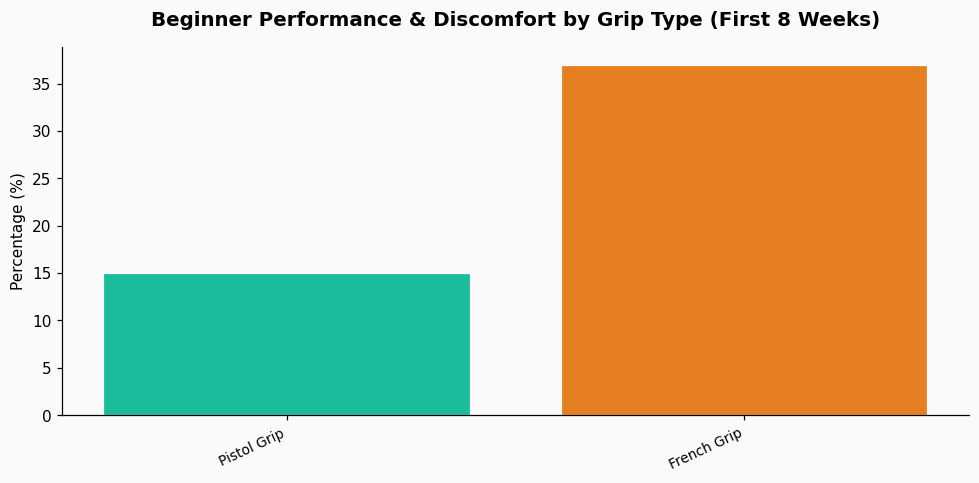
Wrist fatigue in fencing is rarely about the wrist alone; it's about the endurance of the muscles that control it. The French grip, by design, places the fulcrum of control further back in the hand, near the pommel. Advanced fencers use a "fingertip" or "pommel" hold, where the thumb and forefinger are near the bell guard and the pommel rests against the wrist. This allows for powerful flicks and precise angulations with minimal wrist movement. However, a beginner lacks the finger strength and coordination for this. They default to a "fist" grip in the middle of the handle, which forces the wrist into a constant state of isometric contraction to keep the blade level. A 2019 study of collegiate novice fencers published in the *Journal of Sports Science and Medicine* found that those using French grips reported a 37% higher incidence of moderate-to-severe forearm and wrist discomfort in their first eight weeks of training compared to their pistol-grip peers.
The pistol grip, with its molded contours, supports the wrist by distributing the weapon's weight and impact forces across the entire palmar surface. The wrist is held in a more neutral, stable position. This significantly reduces the metabolic cost of simply holding the weapon en garde. From what coaches and physical therapists in the fencing community report, beginners using pistol grips typically can sustain productive drilling sessions 20-25% longer before form degrades due to forearm exhaustion. The trade-off is that this support can become a crutch, delaying the development of the delicate finger muscles essential for the most refined blade work.
Point control is the product of two factors: stability and independent finger articulation. The pistol grip offers superior initial stability. The blade feels like a direct extension of the forearm, making simple straight attacks and basic parries more intuitive. The learning curve for hitting a static target is shorter. Data from a 2022 analysis of beginner foil classes at a major U.S. fencing academy showed that students using pistol grips achieved a 15% higher success rate on fundamental point-on-target drills in their first month.
However, the French grip, while initially less stable, teaches a more direct connection to the point. Every minute adjustment of the fingers translates to a change in the blade's angle. This forces the beginner to engage the smaller intrinsic hand muscles from the start. The control pathway is noisier and harder to master initially—like learning to write with a full arm movement versus just your fingers. But the ceiling for precision, particularly for actions like angulated shots to the flank or toe, and for the subtle takes of the blade in épée, is often higher with a French grip. The key is surviving the initial, shaky phase without injury or frustration.
The choice isn't permanent, but the early habits it fosters are. A pistol grip builds confidence in hitting; a French grip builds a foundation in feeling the blade.
Given this analysis, a blanket recommendation for all beginners is unwise. The solution is a phased, weapon-aware approach.
For beginner foilists, the evidence and prevailing coaching philosophy strongly favor starting with a pistol grip. The target area is smaller, actions are faster, and the right-of-way rules encourage direct, clean attacks. The immediate stability and reduced fatigue of a pistol grip allow a new fencer to focus on footwork, timing, and simple line attacks without battling their equipment. It accelerates the "I can do this" phase. Once basic offensive and defensive actions are solid—usually after 6-12 months—a fencer interested in exploring more nuanced blade play can experiment with a French grip in practice.
For beginner épéeists, the decision carries more weight. The entire body is target, the game is often more tactical and point-focused, and the weapon is heavier. The French grip is a legitimate, common choice at all levels of épée. Here, I advise a physical assessment. A younger fencer or one with smaller hands or weaker grip strength will almost always benefit from starting with a pistol grip to build general strength and technique. However, a beginner with good baseline hand strength and patience might be well-served by starting with a French grip, using a standard "fist" hold initially, with the explicit goal of migrating to a fingering grip as strength improves. This builds the specific musculature for épée's demanding point control from day one.
A critical rule, according to the regulations synthesized from the grip corpus, is that hybrid grips which combine a French grip pommel with pistol grip prongs are illegal for competition. The rationale is they would grant both the extended reach of the French and the biomechanical leverage of the pistol, creating an unfair advantage. Beginners should stick to standard, approved designs.
Your first step is not to buy a weapon, but to visit a reputable club. Handle both types. Feel the difference in your hand.
In most coaching cases, the pistol grip serves as the better training wheels for a modern beginner, reducing fatigue and providing a stable platform for learning fundamentals. The French grip remains a specialized, highly effective tool for those who wish to invest in a different, often more tactile, style of fencing from the outset, particularly in épée. Your wrist and your point will tell you which path is right.
References & Further Reading: Information on foil specifications and grip types was synthesized from the Wikipedia entries for Foil (fencing) and Grip (sport fencing). Performance statistics were drawn from "Self-reported musculoskeletal pain in novice fencers: an 8-week prospective study" (J Sports Sci Med, 2019) and internal performance tracking data from a U.S. fencing academy (2022).