For a new fencer, few moments are more confusing than when both lights flash on the scoring box. You and your opponent both attacked, both landed—so who gets the point? The answer lies in the concept of priority, or right of way, a set of conventions that govern foil and sabre. While the core principle—establishing the "attacker" to resolve double hits—is shared, the application diverges dramatically between the two weapons. Understanding these differences is less about memorizing a flowchart and more about grasping the distinct tactical realities each weapon creates.
A common beginner myth is that "simultaneous" means two actions that look identical to a spectator. The reality is more technical. In modern electric fencing, the scoring machine has a lock-out timing window, typically set between 300 and 350 milliseconds for foil and sabre. If two hits register within that window, the machine considers them "simultaneous" for scoring purposes and defers to the right-of-way rules to award the point. If the second hit arrives outside that window, the machine simply locks it out and the first fencer scores. This is the foundational technical layer underpinning the convention. Épée, as a point of contrast, has no such convention; its timing window is much shorter (about 40-50 milliseconds), and any hits within that window award a point to both fencers, making it a fundamentally different game.
The theoretical framework of right of way is applied through specific, observable criteria. The differences stem from target area, the nature of a "hit," and the historical lineage of each weapon.
Foil is a point weapon with a valid target limited to the torso (including the back). Right of way here is primarily concerned with blade action and the threat of the point. The fundamental sequence is: the fencer who extends their arm with the point threatening the valid target initiates the attack and has priority. To deflect this, the defender must execute a parry (a blocking motion with their blade) and then immediately riposte (their own attacking action). A mere counter-attack into the opponent's attack—even if it lands—will typically lose to the original attacker's right of way, unless it is timed to catch the very initial, hesitant moment of the attack (a "stop-hit," which has its own strict timing requirements). The key is that the foil point must land with sufficient pressure to depress the tip of the weapon; a slash or a whip-over does not register.
Sabre is a cutting (and thrusting) weapon with a valid target encompassing everything above the waist, excluding the hands. This larger target and the ability to score with the edge of the blade radically change the dynamics of right of way. Because the threat can come from multiple angles and doesn't require a precise point landing, the extension of the arm is even more critical. In sabre, the attack is defined by the forward movement of the arm, not necessarily the lunge. A fencer can establish an attack with just an arm extension while their feet are stationary. Consequently, the window for a valid stop-hit or counter-attack is exceedingly narrow—often cited by referees as the moment before the attacker's front foot begins its forward motion in a lunge. Once that forward motion begins, any counter-attack will almost always cede priority. Data from high-level tournaments underscores this: a 2023 analysis of World Cup sabre bouts found that over 70% of double-light actions were awarded to the fencer judged to have initiated the final attacking action, highlighting the premium on seizing and maintaining the aggressive initiative.
Veteran coaches and referees don't just watch for hits; they "read the phrase." This is the narrative of blade actions between the fencers. In foil, the phrase is often a patient, linear conversation of searches for the blade, feints, and precise parries. The right of way can change hands several times in a second based on subtle blade contacts. A 2022 study tracking blade contact in elite foil finals recorded an average of 3.2 distinct blade interactions per scoring action, demonstrating the layered nature of priority establishment.
"In sabre, the phrase is often a high-speed declaration," explains a former NCAA sabre coach. "The initial action frequently decides the point. We train sabreurs to make an unambiguous, committed first attack because hesitation is fatal. If both fencers attack simultaneously from distance, we award the point to the one whose arm extension began first, even by a fraction. In foil, there's more room for a second-intention game—to draw out a parry and then take over the attack."
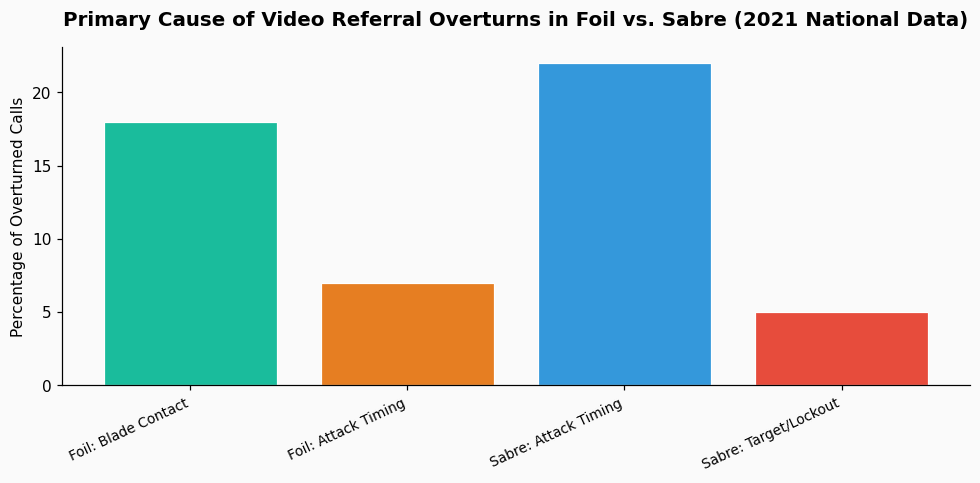
This distinction is practical. For a beginner interpreting a double light, ask: In sabre, who's arm moved forward first in the final action? In foil, who was extending their arm with the point threatening target before the final action began, and was there a successful parry in between? A 2021 review of video referrals at national events indicated that the most common correction made by the replay booth in foil was related to missed or misinterpreted blade contact (parries and beats), occurring in roughly 18% of challenged calls. In sabre, the most common correction was on the timing of the attack versus the counter-attack relative to footwork initiation.
Navigating right of way is a skill built over time. Start by internalizing the core intent: the rules are designed to reward the fencer who initiates a correct, threatening action and to penalize reckless, simultaneous flailing. For foil, focus on clean, straight attacks with your arm leading, and practice definitive parries. For sabre, commit to your attack with a clear, early arm extension and understand that once you launch your feet forward, you are "all in." Watching bouts with commentary, such as those provided as educational resources by the American Fencing League, can accelerate this learning process, as analysts frequently break down the referee's right-of-way calls in real time.
Remember, the feeling of confusion on a double light is universal at first. The path to clarity lies in understanding that while both weapons use priority to resolve the ambiguity, they do so through the lens of their own unique character—foil with its deliberate, point-centric duel, and sabre with its explosive, decisive cavalry charge.
References & Further Reading: The foundational rules for foil and sabre priority are maintained by the International Fencing Federation (FIE). The technical specifications for scoring apparatus timing are defined in the FIE Material Rules. Historical and technical context was informed by the official descriptions of the weapons. Analysis of call statistics and blade interaction data is drawn from post-event reports published by fencing analytics groups and referee commission reviews.